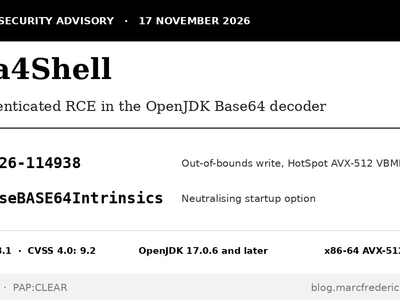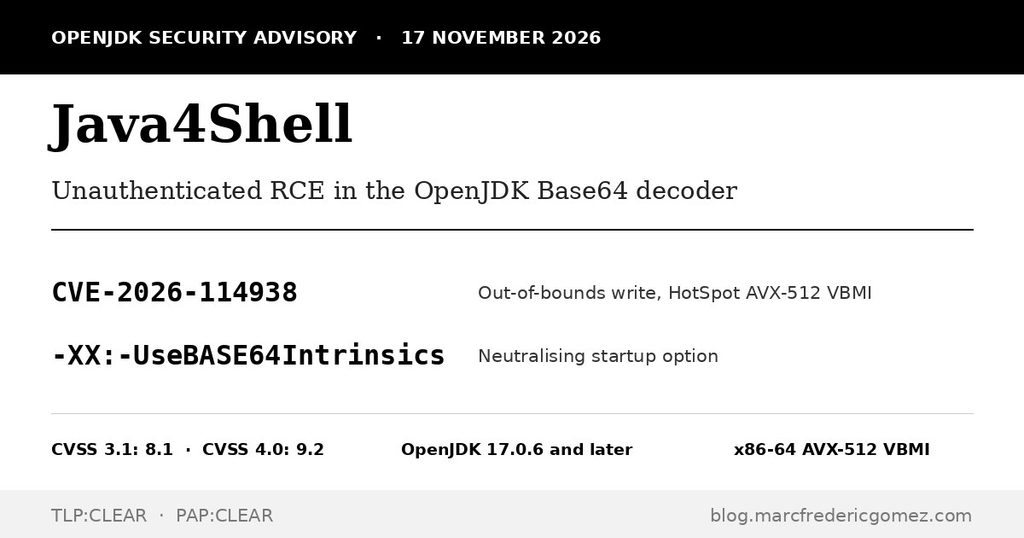
On 17 November 2026, Oracle published CVE-2026-114938, named Java4Shell by its discoverers: an out-of-bounds write in the accelerated Base64 decoder of the OpenJDK Java virtual machine, exploitable without authentication on recent x86-64 servers. Oracle and Amazon have released fixed builds, the other OpenJDK vendors had not yet done so as of 18 November, and a startup option neutralises the vulnerable code in the meantime.
The facts
On 17 November 2026, Oracle published CVE (1) CVE-2026-114938, which the firm Calif, its discoverer, named Java4Shell. It is an out-of-bounds write in the heap of the JVM (2) itself: the flaw does not depend on any application or library. It lies in the assembly routine that HotSpot, the OpenJDK virtual machine, substitutes for Base64 decoding written in Java on x86-64 processors that support the AVX-512 VBMI (3) instructions.
A string of 64 “A” characters followed by a single “=” causes this routine to write 62 bytes beyond the end of the output array. The write occurs before Java rejects the input as invalid. The Java language guarantees memory safety by checking array accesses; this check does not apply to the JVM’s assembly code.
Base64 decoding very often takes place before authentication: authentication headers, tokens, assertions, file uploads. Calif achieved unauthenticated code execution against the default configurations of Keycloak, Jira, Confluence, Artifactory, Jenkins and PingFederate. It is withholding its product-specific exploitation chains, but the root cause, the trigger string and the general technique are public.
The CVSS (4) 3.1 score published by Oracle is 8.1; Calif assigns 9.2 under CVSS 4.0. As of 18 November 2026, no active exploitation has been reported, and the CVE is not listed in the KEV (5) catalogue of the US agency CISA (6). On 17 November, CISA published an alert, with a contribution from the Canadian Centre for Cyber Security, calling for immediate updating, with priority given to internet-facing systems. ARM64 servers are not affected, nor are standard Java 8 and Java 11 builds.
Three cumulative conditions define exposure: an OpenJDK runtime at 17.0.6 or later without a fixed build, including Java 21, 25 and 27; an x86-64 processor with AVX-512 VBMI; attacker-controlled data that reaches the Base64 decoder. Installing the fixed build from the JDK (7) vendor, followed by a restart of every JVM, is the only complete fix; otherwise, the -XX:-UseBASE64Intrinsics startup option removes the vulnerable code.
The mechanism
| Item | Detail |
|---|---|
| CVE | CVE-2026-114938 |
| Common name | Java4Shell |
| CNA (8) | Oracle, published on 17 November 2026 |
| Component | HotSpot, compiler (hotspot/compiler) |
| Type | Heap out-of-bounds write resulting from an integer underflow |
| CVSS 3.1 (Oracle) | 8.1, CVSS:3.1/AV:N/AC:H/PR:N/UI:N/S:U/C:H/I:H/A:H |
| CVSS 4.0 (Calif) | 9.2 |
| Discovery | Albert Yang and Quang Luong (Calif), exploit improvements by Jenish Rakholiya |
Fig. 1. Technical summary of CVE-2026-114938, based on the CVE published by Oracle and Calif’s analysis.
From Java code to the intrinsic routine
When a Java method runs often enough, the HotSpot C2 compiler turns it into native code. For some methods, including Base64 decoding, HotSpot substitutes a hand-written intrinsic routine that processes several bytes at once with specialised processor instructions. On x86-64 with AVX-512 VBMI, the routine decodes input in 256-byte and then 64-byte blocks. A bit mask determines which bytes it is allowed to write.
A length that drops to minus one
The flaw lies in the handling of the end of the string. For a remaining tail made up of a single “=” character, the routine computes an output length of zero, then subtracts one byte for the padding. The length becomes minus one. The mask calculation interprets this value as permission to write the entire block.
For the 65-character input described by Calif, Java allocates a 50-byte array; the routine writes a full 64-byte block into it, 62 bytes of which land beyond the end of the array. These excess bytes corrupt neighbouring objects on the heap. Java rejects the input afterwards, once the corruption has already occurred. Older Java 17 builds require a longer string, 128 “A” characters followed by “=”, because their routine uses different block sizes.
Origin of the vulnerable code
The AVX-512 optimisation of the Base64 decoder (JDK-8268276) was written for JDK 18, then backported to the 17.0.6 update (JDK-8296735, shipped in January 2023). It is absent from 17.0.5 and earlier versions. Oracle’s Java SE 8 Enterprise Performance Pack received the same optimisation, which explains its presence in the scope.
From a fixed write to code execution
The out-of-bounds write carries fixed bytes that the attacker does not choose. Calif turned it into a controlled write through heap grooming, that is, sending requests that arrange heap objects in a predictable order. Calif also built a heap read primitive, named JavaBleed, which returns memory fragments to the attacker. Combining the two primitives leads to code execution.
There is no universal payload. Each target requires its own profile: a path to the decoder, a heap layout, a way to read memory back and an application action to hijack.
Exposure conditions
- OpenJDK 17.0.6 and later
- Java 21, 25 and 27
- Oracle Java SE 8 Enterprise Performance Pack 8u511b33-perf
- Bundled JDKs and container images
- Standard Java 8 and Java 11
- Java 17.0.0 to 17.0.5
- Fixed build installed and JVM restarted
- Intel Xeon Ice Lake, Sapphire Rapids, Emerald Rapids, Granite Rapids
- AMD EPYC and Ryzen Zen 4 and later
- ARM64: AWS Graviton, Apple Silicon
- x86-64 without AVX-512 VBMI
- Default configuration
-XX:-UseBASE64Intrinsics-XX:UseAVX=2(x86-64 only)
- Authentication headers, tokens, assertions
- Encoded fields, uploads
- Java client connected to a malicious server
- No Base64 decoding of external data
Other OpenJDK vendors publish their own build numbers (Fig. 4).
Fig. 2. Exploitation conditions of CVE-2026-114938 and affected Oracle builds per branch, based on the CVE published by Oracle and Calif’s analysis.
Software condition
Every distribution built from OpenJDK 17.0.6 or later is concerned: Oracle Java SE, Oracle OpenJDK, Oracle GraalVM for JDK, Amazon Corretto, Eclipse Temurin, Microsoft Build of OpenJDK, Azul Zulu, BellSoft Liberica, SAP SapMachine and Red Hat OpenJDK. JDKs bundled in products and in container images are concerned in the same way.
Hardware condition
The vulnerable code only runs on an x86-64 processor with AVX-512 VBMI.
| Manufacturer | Generations concerned |
|---|---|
| Intel | Xeon Ice Lake, Sapphire Rapids, Emerald Rapids, Granite Rapids |
| AMD | EPYC and Ryzen Zen 4 and later |
| ARM64, including AWS Graviton and Apple Silicon | Not concerned |
Fig. 3. Processors on which the vulnerable routine runs, according to the sources consulted.
The hardware condition is used to order the work, not to close a finding. An instance resize or a move to newer hardware can place a workload on a concerned processor.
Application condition
Attacker-controlled data must reach the Base64 decoder. The most frequent paths precede authentication:
- HTTP (9) Basic authentication headers
- JWT (10) tokens
- SAML (11) assertions
- encoded API (12) fields and file uploads
Client-side exposure
The researcher samczsun shared a client-side exploit with Calif. A Java program that opens a TLS (13) connection to a malicious server can be compromised, even if it exposes no network service.
Affected builds and fixed builds
| Product | Affected builds | Fixed build |
|---|---|---|
| Oracle Java SE 17 | 17.0.6 to 17.0.21.0.3 | 17.0.21.1 |
| Oracle Java SE 21 | 21.0.13.0.3 and earlier | 21.0.13.1 |
| Oracle Java SE 25 | 25.0.5.0.3 and earlier | 25.0.5.1 |
| Oracle Java SE 27 | 27.0.1.0.3 and earlier | 27.0.1.1 |
| Oracle Java SE 8 Enterprise Performance Pack | 8u511b33-perf | 8u513-perf |
| Oracle GraalVM for JDK | 17.0.21.0.3 and 21.0.13.0.3 | Not specified by the sources consulted |
| Oracle GraalVM Enterprise Edition | 21.3.20.0.3 | Not specified by the sources consulted |
| Amazon Corretto 17 | 17.0.6 and later | 17.0.21.1.2 |
| Amazon Corretto 21, 25 and 27 | Up to 21.0.13.0.11, 25.0.5.0.10 and 27.0.1.0.11 | 21.0.13.1.2, 25.0.5.1.2 and 27.0.1.1.4 |
| Eclipse Temurin, Azul Zulu, Microsoft, BellSoft Liberica, SAP SapMachine, Red Hat | 17.0.6 and later, 21, 25 and 27 | Not confirmed as of 18 November 2026 |
| openjdk packages of Linux distributions | 17.0.6 and later, 21 and 25 | Not confirmed as of 18 November 2026 |
Standard Java 8 and Java 11, Java 17.0.0 to 17.0.5 | Not affected | Not applicable for this CVE |
Fig. 4. Affected builds and fixed builds, based on the CVE published by Oracle, Qualys, Cyber Kendra and Aikido. The Corretto 21, 25 and 27 fixed builds are given by Aikido only.
The CVE published by Oracle lists, for each branch, the latest supported version that is affected. Earlier versions of the branch are affected as long as they contain the code introduced in 17.0.6. Oracle build numbers apply only to Oracle products; each OpenJDK vendor publishes its own numbers.
As of 17 November 2026, the fix was not yet present in the public jdk17u, jdk21u and jdk25u repositories from which most vendors build their distributions. Their fixed builds are expected in the coming days, with no announced date.
Oracle’s update of 17 November 2026 fixes 11 Java SE vulnerabilities, all remotely exploitable without authentication. The Java 8 (8u513) and Java 11 (11.0.33.1) builds released on the same day fix other CVEs and should be installed on that basis.
Products on which exploitation has been demonstrated
Calif demonstrated code execution on the following products, in their default configuration, stating that these lists are not exhaustive.
| Access required | Products |
|---|---|
| None, before authentication | Keycloak, Atlassian Jira, Atlassian Confluence, JFrog Artifactory, Jenkins, PingFederate |
| Authenticated account | Apache Kafka Broker, Apache Solr, Elasticsearch, Gerrit, Spinnaker |
| Sample applications | Applications built on Apache Struts and Spring Boot |
Fig. 5. Products exploited by Calif. Cyber Kendra and Qualys relay these lists without independent verification.
Identity providers issue the tokens that other systems trust. Build and artefact servers sign and distribute software. The compromise of one of them exposes the systems that depend on it.
The heap read primitive makes it possible to extract memory before any code execution: private keys, tokens, personal data. Malformed input can also cause the JVM to crash.
Exposure verification
These commands only read the state of the system. They are run on every server and inside every container that runs Java.
Step 1: hardware condition on Linux
grep -m1 '^flags' /proc/cpuinfo | tr ' ' '\n' | grep -E '^(avx512f|avx512bw|avx512vbmi|bmi2)$'
The host meets the hardware condition if all four flags are displayed. The command reproduces Calif’s.
Step 2: running runtimes
java -version only reports the first runtime on the execution path. The runtime actually loaded by each service is read as follows:
ps -eo pid,args | grep '[j]ava'
readlink -f /proc/<PID>/exe
jcmd <PID> VM.version
jcmd <PID> VM.flags
Step 3: runtimes not managed by packages
find / -xdev -type f -name release -path '*j*' 2>/dev/null | xargs grep -H '^JAVA_VERSION=' 2>/dev/null
In containers: docker exec <container> java -version or kubectl exec. On Windows: java -version for each installed runtime, and a search for bin\java.exe in application installation directories.
Jira, Confluence, Jenkins and many other products bundle their own JDK. The system package manager does not update it.
Confirmation on a given runtime
Calif’s analysis includes a self-contained test program. It exercises the decoder until the intrinsic routine is triggered, decodes the malformed input into a 4,096-byte array and prints REPRODUCED if the 62-byte write appears. All writes stay inside a real array; the test does not crash the JVM. It is run on a non-production machine with the same processor and the same build.
Qualys has published a dedicated detection, under identifier 389494. Wiz offers a query in its Threat Center.
GitHub repositories carrying the CVE have multiplied since the leak. Fake POCs (14) that deliver malware are common after a disclosure of this scale. No third-party script should be run without reading it first.
Mitigation measures
Fixed build. Installing the fixed build from the JDK vendor is the only complete fix. Every Java process must be restarted: replacing the files does not change a JVM that is already running.
Preferred startup option: -XX:-UseBASE64Intrinsics. It disables the intrinsic Base64 routine. Java falls back to the standard decoder; everything else runs unchanged. Applications that decode large volumes of Base64 may slow down. The option requires a restart.
Alternative option: -XX:UseAVX=2. It disables all AVX-512 optimisations, including the vulnerable routine, at a broader performance cost. It is used on x86-64 only: OpenJDK on ARM does not recognise the option and refuses to start. It must therefore not be rolled out through a mechanism shared across a mixed x86-64 and ARM64 estate.
Verifying the option. An option added in a shell profile often does not reach services started by systemd, Tomcat scripts or container entrypoints. The JAVA_TOOL_OPTIONS environment variable applies it across all launchers. It is verified as follows:
java -XX:+PrintFlagsFinal -version | grep -i base64
jcmd <PID> VM.flags
Servers that cannot be restarted. The firm Theori has published a hot patch. It attaches a Java agent to the running JVM and keeps the vulnerable Base64 method out of C2 compilation. Its limits:
- it lives in memory and is lost on restart
- it does not repair corruption that has already occurred
- it can cause a processor usage spike while code is recompiled
VM.flagsstill shows the intrinsic routine as enabled, even when the patch is working- its quick-install command pipes a script from Theori’s server straight into the shell
Its use is a decision for the system operator, after reading and testing the script. It only serves as a bridge to a restart with the option or with the fixed build.
Reducing exposure. The administration consoles of Keycloak, Jira, Jenkins and comparable products are removed from the internet, or placed behind a VPN (15) or an allow list, until they are fixed.
A reverse proxy or a WAF (16) is not a reliable protection. Buffering the full request, nginx’s default behaviour, disrupts some of Calif’s exploitation chains. It is not a general mitigation: the Elasticsearch chain works from a single complete request, and WebSocket traffic bypasses buffering. Among its temporary measures, CISA cites validation of Base64 input and an input size limit. The size limit does not protect against this CVE, as the malformed input is only 65 characters long.
Order of treatment
| Order | Scope | Treatment |
|---|---|---|
| 1 | Entire estate | Inventory of Java runtimes (packages, standalone installations, bundled JDKs, container images) and record of the hardware condition of each host |
| 2 | Internet-facing identity providers, Keycloak and PingFederate | Fixed build, otherwise the -XX:-UseBASE64Intrinsics option, then restart |
| 3 | Internet-facing Jira, Confluence, Jenkins and Artifactory | Same treatment |
| 4 | Other internet-facing Java services handling authentication, tokens or uploads | Same treatment |
| 5 | Internal systems, starting with Kafka, Solr, Elasticsearch, Gerrit and Spinnaker | Same treatment |
| 6 | Java client applications opening outbound TLS connections | Inclusion in the inventory and same treatment |
| 7 | Container images | Rebuild on a fixed base image and redeploy, as soon as the vendor’s fixed build is published |
| 8 | Products that bundle their JDK | Apply the versions released by the publishers of these products, as soon as they are released |
Fig. 6. Proposed order of treatment, from internet-facing services that decode data before authentication to internal systems.
At each intervention, the check covers the build actually loaded by each process, with jcmd <PID> VM.version, and whether the option is in effect, not only the installed package.
Detection and compromise hunting
No indicator of compromise has been published as of 18 November 2026. Hunting relies on the behaviour of Java processes. CISA asks organisations to monitor unknown runtimes, unexpected JVM crashes and suspicious Java processes. The following leads are intended for SOC (17) teams.
Unexplained JVM crashes
Memory corruption exploits often crash the target several times before succeeding. A crashed JVM writes a hs_err_pid<PID>.log file to its working directory. On Linux, the system log contains A fatal error has been detected by the Java Runtime Environment or a SIGSEGV associated with libjvm.
A crash whose frame involves Base64 or StubRoutines, on an internet-facing service, should be treated as a possible exploitation attempt.
Child processes of Java services
Launch by a java, java.exe or javaw.exe process of a command interpreter or a download tool: sh, bash, cmd.exe, powershell.exe, python, curl, wget, nc, certutil.exe, mshta.exe, bitsadmin.exe, rundll32.exe. Build tools, application servers and schedulers legitimately start shells; a baseline of normal behaviour per service precedes alerting.
New outbound connections
Public destinations contacted by a Java service for the first time since the disclosure, compared with an earlier reference period.
Unknown runtimes
Java runtimes present on a host and absent from the inventory.
In case of suspicion
- preserve evidence before any restart:
hs_err_pidfiles, application and access logs, a memory image of the Java process where possible - isolate the host from untrusted networks
- trigger the organisation’s incident response procedure
- consider as exposed the secrets readable by the service: database passwords, API keys, signing keys, cloud credentials. The heap read primitive allows their extraction without code execution
Source qualification
The CVE published by Oracle is the primary source for the description and the Oracle versions, the CISA alert for prioritisation and temporary measures. Calif’s analysis is known through the coverage by Cyber Kendra and Qualys. The other sources are publications by security vendors, which diverge on several points.
| Item | Status | Comment |
|---|---|---|
| CVE, affected Oracle versions, CVSS 3.1 score of 8.1 | corroborated | CVE published by Oracle on 17 November 2026, reported by Qualys, Cyber Kendra and Orca Security. |
| Mechanism, trigger string and startup options | corroborated | Calif’s analysis, relayed by Cyber Kendra and Qualys; history of the code in the OpenJDK sources established by Orca Security. |
| CVSS 4.0 score of 9.2 | corroborated | Calif. Both scores describe the same vulnerability; the “high” complexity of the CVSS 3.1 vector reflects heap grooming and per-application tuning. |
| CISA alert of 17 November 2026 | corroborated | Text published by CISA, reported by several sources; the Canadian Centre for Cyber Security contributed to it. Among the temporary measures cited, the input size limit does not protect against this CVE. |
| Products on which exploitation has been demonstrated | single source | Calif alone; Cyber Kendra and Qualys relay these lists without independent verification. |
| Corretto 21, 25 and 27 fixed builds | single source | Aikido alone; Cyber Kendra and Qualys only mention Corretto 17. |
| Notice attributed to the NCSC (18) of South Korea, assigning the 9.2 score | single source | ThreatDefence alone. |
| No link between the CVE and Oracle’s fixes | discarded | Stated by Orca Security and ThreatDefence on 17 and 18 November; the CVE published by Oracle on 17 November and the OpenJDK advisory establish this link. |
| Java 17 affected before 17.0.6 | discarded | Aikido lists all Java 17 versions earlier than 17.0.21.1; the vulnerable code is absent before 17.0.6, according to the OpenJDK source history and Calif’s analysis. |
| No workaround | discarded | Stated by Aikido; Calif has since published the -XX:-UseBASE64Intrinsics option. |
| Processor check command published by ThreatDefence | discarded | The pattern avx512_vbmi does not match the name exposed by Linux, avx512vbmi; combined with grep’s -w option, it does not detect VBMI. The command in the Exposure verification section reproduces Calif’s. |
Assessment
Calif experienced a comparable disclosure leak in October 2026 with php2shell; the two CVEs concerned were exploited in less than a week and added to the KEV catalogue. For Java4Shell, the trigger string and the general technique have been public since 17 November.
Analysis based on the CVE published by Oracle, the CISA alert and the publications of Qualys, Orca Security and Aikido of 17 November 2026, and of Cyber Kendra and ThreatDefence of 18 November 2026; Calif’s analysis is known through this coverage. Version numbers are taken from these sources. The levels in the grid are a matter of judgement. The release of fixed builds by the other OpenJDK vendors, a KEV listing or the publication of indicators of compromise would justify an update of this article.
Glossary
- CVE (1) : Common Vulnerabilities and Exposures, public identifier assigned to a vulnerability.
- JVM (2) : Java Virtual Machine, virtual machine that runs Java code.
- AVX-512 VBMI (3) : Advanced Vector Extensions 512 bits, Vector Byte Manipulation Instructions, vector instruction set of x86-64 processors.
- CVSS (4) : Common Vulnerability Scoring System, system for rating vulnerability severity.
- KEV (5) : Known Exploited Vulnerabilities, CISA catalogue of vulnerabilities whose exploitation has been observed.
- CISA (6) : Cybersecurity and Infrastructure Security Agency, US cybersecurity and infrastructure security agency.
- JDK (7) : Java Development Kit, Java distribution that contains the JVM.
- CNA (8) : CVE Numbering Authority, organisation authorised to assign CVEs and publish their records; here Oracle.
- HTTP (9) : Hypertext Transfer Protocol, the web transfer protocol.
- JWT (10) : JSON Web Token, Base64-encoded authentication token.
- SAML (11) : Security Assertion Markup Language, standard for exchanging authentication assertions.
- API (12) : Application Programming Interface.
- TLS (13) : Transport Layer Security, protocol for encrypting communications.
- POC (14) : Proof of Concept, code demonstrating that exploitation is feasible.
- VPN (15) : Virtual Private Network.
- WAF (16) : Web Application Firewall.
- SOC (17) : Security Operations Center.
- NCSC (18) : National Cyber Security Center, here South Korea’s national cybersecurity agency.
- AI (19) : artificial intelligence.
Sources
- CVE Program, CVE-2026-114938 record, CNA Oracle, published on 17 November 2026. cve.org
- Calif, Java4Shell: Write once, RCE everywhere, 17 November 2026, known through the coverage by Cyber Kendra and Qualys.
- Qualys, How to Find, Mitigate, and Patch the Critical Java4Shell Flaw (CVE-2026-114938) Now, 17 November 2026. blog.qualys.com
- Orca Security, analysis of Java4Shell, 17 November 2026. orca.security
- Aikido, analysis of CVE-2026-114938, 17 November 2026. aikido.dev
- CISA, Critical Java Vulnerability Requires Immediate Patching, 17 November 2026. cisa.gov
- Cyber Kendra, analysis of CVE-2026-114938, 18 November 2026. cyberkendra.com
- ThreatDefence, analysis of Java4Shell, patching and compromise hunting, 18 November 2026. threatdefence.com
Marked TLP:CLEAR, PAP:CLEAR. Unlimited disclosure, no restriction on use.
The analysis presented here reflects the author’s own views and rests on the public sources listed above.