Executive Summary
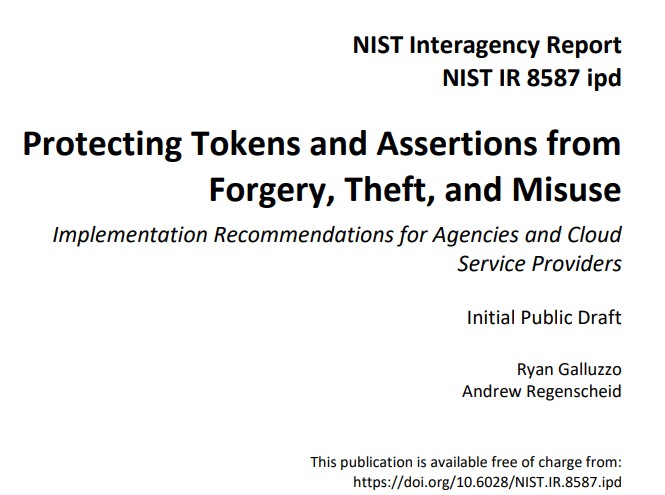
On December 22, 2024, the Cybersecurity and Infrastructure Security Agency (CISA) and the National Institute of Standards and Technology (NIST) published the initial draft of interagency report IR 8597 “Protecting Tokens and Assertions from Forgery, Theft, and Misuse”. This document is subject to public consultation until January 30, 2026, with comments submitted to iam@list.nist.gov.
This publication comes in direct response to major security incidents at several cloud providers (Storm-0558 in 2023, Midnight Blizzard in 2024), where state actors compromised critical systems through theft, modification, or forgery of identity tokens. The report operates within the framework of Executive Orders 13694 and 14144, as amended by EO 14306 in June 2025.
The report establishes a control framework for Identity Access Management (IAM) systems based on digitally signed assertions and tokens. It defines respective responsibilities of Cloud Service Providers (CSPs) and cloud consumers (notably federal agencies) in secure management of the complete token lifecycle: issuance, signing, distribution, validation, usage, revocation, and logging.
Guiding principles rest on CSP application of Secure by Design, architectural transparency, security control configurability, and interoperability. The report advocates adoption of sender-constraining technologies such as DPoP (Demonstration of Proof-of-Possession) and mTLS for high-privilege tokens.
Context and Triggering Incidents
Storm-0558 (May-June 2023)
The Storm-0558 attack, attributed to an APT group linked to the People’s Republic of China, constitutes the foundational incident that catalyzed this initiative. The group compromised 22 enterprise organizations and 503 associated personal accounts via exploitation of a compromised Microsoft Account (MSA) key.
Technical Timeline:
- April 2021: exfiltration of a private MSA key via crash dump present in debugging environment connected to Microsoft corporate network
- May-June 2023: use of the key to forge Azure AD tokens enabling Exchange Online access via Outlook Web Access
- June 16, 2023: detection of malicious activity by a U.S. government customer
Technical Vectors Exploited:
- Compromised MSA key enabled signing of valid OpenID v2.0 tokens for multiple Azure AD application types
- Exploitation of validation error in Microsoft code: Exchange Online systems accepted tokens signed with consumer MSA key to access enterprise resources
- Absence of strict issuer/scope validation at token validation library level
- Compromised key was present in crash dump due to undetected race condition during extraction from secure signing environment
- Compromise of Microsoft engineer account via token-stealing malware to access debugging environment
Organizational Consequences: The Cyber Safety Review Board report (April 2024) identified a corporate culture neglecting investment in security and rigorous risk management. Microsoft was criticized for inaccurate public statements regarding the origin of the compromised key, initially attributed to a crash dump but never found despite investigations.
Midnight Blizzard (November 2023 – March 2024)
The Midnight Blizzard operation, attributed to Russian APT group Nobelium (SVR), targeted Microsoft’s corporate environment with espionage objectives aimed at leadership and cybersecurity teams.
Initial Access Vector:
- Password spraying attack using residential proxies to evade detection
- Compromise of legacy non-production test account without multi-factor authentication (MFA)
- Compromised account had elevated access to corporate environment
Attack Progression:
- Identification and compromise of legacy test OAuth application with elevated access
- Creation of new user account in Microsoft corporate environment
- Use of created account to consent to attacker-controlled malicious OAuth applications
- Exploitation of test application to grant Office 365 Exchange Online “full_access_as_app” role via Exchange Web Services (EWS) API
Activity Period:
- November 2023: intrusion began
- January 12, 2024: malicious activity detected
- March 2024: confirmation of attacker source code access
Identified Failures:
- Absence of cleanup of legacy test accounts and tenants
- MFA not enabled on privileged accounts
- Insufficient monitoring of OAuth consents and account creations
- Detection via EWS logs only, absence of proactive telemetry
Regulatory Framework and Executive Orders
Executive Order 13694 (Obama, April 2015)
EO 13694 “Blocking the Property of Certain Persons Engaging in Significant Malicious Cyber-Enabled Activities” establishes the initial framework of sanctions against malicious actors in cyberspace. It uses authorities conferred by the International Emergency Economic Powers Act (IEEPA), National Emergencies Act (NEA), and Immigration and Nationality Act (INA).
Original Scope:
- Sanctions limited to “significant” events
- Targeting computer network compromise activities
- Illicit misappropriation of funds or information
Subsequent Modifications:
- EO 13757 (December 2016): additional measures
- EO 13984 (January 2021): extension of sanctions criteria
Executive Order 14144 (Biden, January 16, 2025)
EO 14144 “Strengthening and Promoting Innovation in the Nation’s Cybersecurity” constitutes a major overhaul of federal cybersecurity policy in the final days of the Biden administration.
Principal Provisions:
- Mandatory attestations of secure development practices for software vendors to federal government
- Cybersecurity requirements in Federal Acquisition Regulation (FAR)
- Directives for deployment of digital driver’s licenses and digital identity verification
- Post-quantum cryptography adoption mandates
- Improved AI adoption for security applications and cybersecurity function automation
- Removal of “significant” threshold for cybersecurity sanctions from EO 13694
- Extension of sanctions grounds: intellectual property misappropriation, confidential business information, personal identifiers, financial information, unauthorized access to U.S. systems
New CSP Responsibilities:
- Application of Secure by Design principles
- Architectural transparency
- Security control configurability
- Cryptographic protection of signing keys
- Automatic key rotation
- Vulnerability disclosure via CVE process
Executive Order 14306 (Trump, June 6, 2025)
EO 14306 “Sustaining Select Efforts to Strengthen the Nation’s Cybersecurity and Amending Executive Order 13694 and Executive Order 14144” selectively modifies EO 14144 provisions while maintaining its general framework.
Changes Made:
- Explicit identification of People’s Republic of China as most active and persistent cyber threat
- Maintenance of significant threats from Russia, Iran, North Korea
- Removal of certain secure software development attestation requirements (machine-readable format, centralized CISA validation)
- Exemption of National Security Systems and debilitating impact systems (except post-quantum cryptography provisions)
- Reorientation of sanctions authorities toward “foreign” actors only
- Maintenance of Cyber Trust Mark obligation for IoT products sold to government (deadline January 4, 2027)
- Establishment of rules-as-code pilot program for machine-readable versions of OMB, NIST, CISA cybersecurity policies and guidance
- Directive to NIST to develop guidelines for secure management of access tokens and cryptographic keys used by CSPs
NIST Charge:
- Update of Secure Software Development Framework (SSDF)
- Establishment of industry consortium at National Cybersecurity Center of Excellence (deadline August 1, 2025)
- Update of NIST SP 800-53 with guidance on secure patch and update deployment
- Development of guidelines for secure management of access tokens and CSP cryptographic keys (origin of IR 8597)
Technical Content of NIST IR 8597
Document Architecture
IR 8597 report addresses IAM controls for systems relying on digitally signed assertions and tokens in access decision-making. It establishes a shared responsibility model between CSPs and cloud consumers.
Technical Scope:
- Access tokens
- Refresh tokens
- SAML assertions
- OpenID Connect tokens (ID Tokens)
- Cryptographic signing keys
- Validation and introspection systems
Token Lifecycle
The report structures its recommendations around the complete token lifecycle:
1. Issuance
Design Principles:
- Preference for opaque tokens at resource server level
- Token lifetime limitation according to privilege level
- Use of unique session identifiers (jti claims)
- Issuance conditional on proof-of-possession presence for high-privilege flows
CSP Controls:
- Isolation of token issuance systems
- Signing key protection in Hardware Security Modules (HSM) FIPS 140 Level 1 minimum for AAL2, mandatory for AAL3
- Signing key separation per RP (Relying Party) for shared-key MACs
- Nonce generation for replay prevention
Consumer Controls:
- Contractual issuance policy validation
- Issued token lifetime verification
- OAuth consent and application creation audit
2. Signing and Cryptographic Protection
Algorithmic Standards:
- Asymmetric signature: use of same public/private key pair authorized for signing assertions to multiple RPs
- Symmetric key MAC: different key mandatory for each RP
- Public key publication in verifiable manner (HTTPS-protected URL, well-known location)
- Approved algorithms per FIPS cryptography
Key Protection:
- Storage in HSMs or Azure Confidential VM environments
- Automatic signing key rotation
- Isolation of foundational key management systems
- Credential scanning in crash dumps and production environment exports
Microsoft Post-Storm-0558 Evolutions:
- Migration of MSA and Entra ID signing services to Azure Confidential VMs
- Use of single hardened identity SDK to validate 90% of tokens issued by Entra ID for Microsoft applications
- Stateful validation of identity tokens rather than validation based solely on self-contained claims
3. Distribution and Transport
Distribution Channels:
- Front-channel (via browser): mandatory assertion encryption (FAL2 minimum)
- SAML: XML-Encryption encryption
- OpenID Connect: JSON Web Encryption (JWE) encryption
- Back-channel (direct IdP-RP): optional encryption if authenticated protected channel
In-Transit Protection:
- TLS 1.2 minimum required for all exchanges
- TLS alone insufficient for FAL2: requires message-level encryption
- Reason: TLS only protects individual links, not assertion itself in front-channel flows
Audience Restriction:
- All RPs must verify assertion audience contains identifier for their RP
- Prevention of injection and replay of assertions generated for one RP at another RP
- Implementation via aud claims in JWT or AudienceRestriction in SAML
4. Validation
RP-side Validation:
- Source authentication (verifier)
- Assertion integrity confirmation
- Signature verification with approved cryptography
- Strict issuer/scope validation (Storm-0558 lesson)
- Audience restriction verification
- Validity duration control
Storm-0558 Identified Failures:
- Microsoft libraries provided cryptographic signature validation API but without automatic scope validation
- Developers incorrectly assumed libraries performed complete validation
- Acceptance of requests for enterprise email with token signed by consumer key
- Correction via library update and mandatory issuer/scope validation addition
Validation Recommendations:
- Avoid blind trust in self-contained JWTs at resource boundaries
- Prioritize online validation (introspection) for long-lived or privileged tokens
- Standardization of token acquisition and validation mechanisms
- Stateful validation rather than based solely on token claims
5. Usage and Sender-Constraining
Bearer Token Problem: Traditional bearer tokens allow any holder to access protected resources. In case of theft, the token can be replayed until expiration without possibility of distinguishing between legitimate user and attacker.
DPoP (Demonstration of Proof-of-Possession) – RFC 9449:
Application-level sender-constraining mechanism, binding token to public/private key pair.
Technical Operation:
- Client generation of asymmetric key pair (public/private)
- Creation of DPoP proof JWT containing:
- Public key in JWT header
- Claims htm (HTTP method) and htu (target URL)
- Claim iat (issuance timestamp)
- Claim jti (unique JWT identifier)
- Signature with private key
- Sending of DPoP proof in DPoP HTTP header during token request
- Authorization server binds public key to token via confirmation claim (cnf) containing JWK SHA-256 Thumbprint (jkt)
- For each token use, client generates new DPoP proof with:
- Same keys
- htm/htu values corresponding to current request
- Hash of access token (claim ath)
- Resource server verifies:
- DPoP proof signature with included public key
- Correspondence between proof public key and token jkt
- htm/htu claims validity
- jti uniqueness (replay prevention)
DPoP Advantages:
- Works at application level, suitable for SPAs and mobile applications
- Does not require X.509 certificates
- Operationally lighter than mTLS
- Prevents use of stolen tokens without corresponding private key
mTLS (Mutual TLS) – RFC 8705:
Transport-level sender-constraining mechanism via client certificates.
Characteristics:
- Gold standard for sender-constrained tokens
- Mutual client-server validation via X.509 certificates
- High operational complexity (certificate issuance, management, revocation)
- Impossible for public clients (SPAs, mobile applications) unable to securely store secrets
- Infrastructure complexity: edge termination, TLS renegotiation
- Preferred if available but DPoP recommended as alternative
IR 8597 Recommendations:
- Adoption of DPoP or mTLS for refresh tokens
- Mandatory for high-privilege flows
- DPoP token scheme (not Bearer) to indicate sender-constraining
- Refresh token rotation with token family invalidation upon suspicious reuse detection
6. Revocation
Revocation Mechanisms:
- Immediate token revocation upon compromise notification
- Token family invalidation (refresh token rotation)
- Coordinated revocation between IdP and RPs
- Revocation list publication (similar to CRL/OCSP for certificates)
Revocation Triggers:
- Abnormal activity detection (unusual pattern, multiple geographies)
- Suspicious consent changes
- Token replay detection
- User-reported or automatic detection of compromise
Organizational Controls:
- Documented and tested revocation policy
- Notification procedures for concerned parties
- Coordination between security and operations teams
7. Logging and Telemetry
Events to Log:
- Token issuances (with context: client, scope, duration)
- OAuth consent events
- Administrator consents
- Token introspection calls
- Validation failures
- Token revocations
- Application privilege modifications
Recommended SIEM Detections:
- Unusual refresh patterns
- Token reuse from multiple geographies
- Consent changes
- Abnormal introspections
- Token use after revocation attempt
Multi-Source Correlation:
- Correlation with EDR for host-based indicators
- Network context enrichment
- Unified timeline of identity events
Retention and Compliance:
- Retention policy per risk assessment
- Compliance with NARA records retention schedules for federal agencies
- Balance between investigation and privacy
Guiding Principles for CSPs
Secure by Design
Application of security principles from design rather than as post-deployment addition.
Implementation:
- Security by default in configurations
- Attack surface minimization
- Defense in depth with multiple control layers
- Fail secure: failure toward secure state
Token-Specific Controls:
- Minimum default lifetime per privilege level
- Sender-constraining enabled by default for sensitive flows
- Automatic signing key rotation
- Strict validation enabled by default (no opt-in required)
Transparency
Publication of information enabling consumers to verify security controls.
Elements to Document:
- Token issuance and validation system architecture
- Cloud deployment models used
- Applied cryptographic controls
- Token lifetime policies
- Available revocation mechanisms
- Logging and telemetry capabilities
- Metadata endpoints (/.well-known)
Disclosure Standards:
- CVE publication of all vulnerabilities, including token validation logic flaws
- Collaboration with CVE Program to develop CWEs adapted to cloud environments
- Timely and comprehensive disclosure to enable informed risk decisions
Configurability
Provision of configurable controls enabling consumers to align security posture with their threat environment.
Required Configurable Parameters:
- Token lifetimes (access, refresh, ID tokens)
- Rotation policies
- Logging level
- Sender-constraining mechanisms (DPoP/mTLS activation)
- Issued token scopes
- Audience restrictions
Management Interfaces:
- Programmatic APIs for configuration
- Integration with policy management systems
- Configuration validation before application
- Rollback capabilities
Interoperability
Respect for open standards to enable integration and portability.
Supported Standards:
- OAuth 2.0 and extensions (RFC 6749, RFC 8693, RFC 9449)
- OpenID Connect
- SAML 2.0
- JWT (RFC 7519)
- JWE (RFC 7516)
- JWS (RFC 7515)
- Token introspection (RFC 7662)
- Token revocation (RFC 7009)
Avoiding Proprietary Lock-in:
- Open standard implementation without mandatory proprietary extensions
- Documentation of optional proprietary extensions
- Migration path to alternative implementations
Guiding Principles for Cloud Consumers (Federal Agencies)
Architectural Understanding
Pre-Procurement Due Diligence:
- Analysis of CSP IAM architecture
- Identification of deployment models (public, private, hybrid, community cloud)
- Mapping of token and assertion flows
- Identification of validation and control points
Risk Alignment:
- Agency threat model assessment
- Mapping of CSP controls to agency security requirements
- Control gap identification
- Determination of necessary compensating controls
Required CSP Documentation:
- IAM architecture diagrams
- Token/assertion data flows
- Detailed shared responsibility model
- Certifications and audits (FedRAMP, SOC 2, ISO 27001)
Contractual Requirements
Security SLAs:
- Maximum token lifetimes per type and privilege level
- Guaranteed revocation timelines
- Minimum logging level
- Log retention
- Incident notification involving tokens/assertions
Contractual Transparency:
- Access to IAM configuration metadata
- Periodic reporting on identity-related security incidents
- Disclosure of architectural changes impacting security
- Access to independent audit results
Migration Clauses:
- Identity and data portability
- Revocation procedures during offboarding
- Post-contract retention timeline
Organizational Controls
Governance:
- Clear ownership of cloud IAM management
- Approval process for new integrations
- Periodic OAuth consent review
- Application and service principal audit
Operations:
- Active monitoring of token issuance and usage
- Usage anomaly investigation
- Compromised token incident response procedures
- Regular revocation mechanism testing
Training:
- Awareness of token risks (phishing, token theft)
- Procedures for reporting suspected compromise
- Best practices for credential management in the cloud
Immediate Operational Recommendations
For Security Teams
Token Lifecycle Hardening:
- Current State Audit:
- Inventory of token types used (access, refresh, ID tokens, SAML assertions)
- Mapping of current lifetimes
- Identification of long-lived or non-expiring tokens
- Census of legacy applications using insecure patterns
- Technical Control Implementation:
- Prefer opaque tokens with mandatory introspection for long-lived tokens
- Avoid blind trust in self-contained JWTs without online validation
- Implement sender-constraining (DPoP/mTLS) for refresh tokens and privileged flows
- Enable refresh token rotation with per-session identifiers (jti)
- Invalidate token families upon suspicious reuse detection
- Visibility Improvement:
- Centralize logs of token issuance, consent events, introspection calls
- Build SIEM detections for abnormal refresh patterns, token reuse from multiple geographies, consent changes
- Correlate with EDR for host-based indicators (token stealer malware)
- Establish normal behavior baseline per application type and user
- Cleanup and Hygiene:
- Revoke undocumented legacy identity endpoints
- Enforce strict issuer/audience validation at API gateways
- Disable test accounts and applications in production environments or with elevated privileges
- Audit and cleanup of non-production tenants with production environment access
For Procurement Managers
Requirements in RFPs/Contracts:
- Architectural Transparency:
- Complete CSP IAM architecture documentation
- Token/assertion flow diagrams
- Explicit shared responsibility model
- Identification of cryptographic protection mechanisms used
- Security Guarantees:
- Signing key protection in HSMs with FIPS 140 certification
- Automatic key rotation with specified timeline
- DPoP and mTLS support for sender-constraining
- Maximum token lifetimes per type
- Guaranteed revocation timelines
- Visibility and Controls:
- Available logging levels
- Token introspection APIs
- IAM policy configuration interfaces
- Audit and reporting mechanisms
- Compliance and Audit:
- Applicable certifications (FedRAMP, SOC 2 Type II, ISO 27001)
- Frequency and scope of independent audits
- Vulnerability disclosure process
- Compliance history
- Incident Response:
- Notification procedures for incidents involving token compromise
- Revocation SLAs
- Forensics and investigation capabilities
- Incident support
For Developers and Architects
Secure Pattern Implementation:
- Cloud-Native Application Design:
- Use short-lived tokens with automatic refresh
- Implement DPoP for client-heavy applications
- Avoid token storage in localStorage (use httpOnly cookies or in-memory storage)
- Implement token binding at application level
- Rigorous Validation:
- Never trust solely on self-contained JWT claims
- Implement strict issuer/audience validation
- Verify cryptographic signatures with keys obtained from authenticated sources
- Systematically validate timestamp and expiration
- Reject tokens with “none” algorithm
- Secret Protection:
- Never include tokens or credentials in plaintext in source code or binaries
- Use secrets managers for storage
- Regular credential rotation
- Minimize token lifetime in memory
- Logging for Investigation:
- Log token issuance and validation (not tokens themselves)
- Include sufficient context for investigation (timestamp, client ID, user ID, scope, validation result)
- Protect logs against modification
- Implement appropriate retention
Public Consultation Process
Timeline
- Draft Publication: December 22, 2024
- Consultation Period End: January 30, 2026
- Duration: approximately 13 months
This extended duration enables thorough review by multiple stakeholders: federal agencies, CSPs, security researchers, practitioners.
Comment Submission
Email Address: iam@list.nist.gov
Recommended Format:
- Clear and actionable comments
- Specific language proposals for service-level statements
- Identification of missing or to-be-standardized telemetry fields
- Migration timelines for proposed control adoption
- Operational impact of suggested technical controls on existing systems
Priority Audiences:
- Federal agencies: feedback on applicability and feasibility in government contexts
- Major CSPs: feedback on implementation constraints, existing industry standards, compatibility
- Security teams: technical control validation, gap identification
- Researchers: formal analysis of proposed mechanisms, potential weakness identification
Value of Structured Comments
The most useful comments for NIST and CISA will include:
- Technical Precision:
- References to existing standards (RFCs, ISO, NIST SP)
- Concrete use cases and real attack scenarios
- Measurable security metrics
- Operational Impacts:
- Implementation complexity estimation
- Migration costs from existing architectures
- Realistic deployment timelines
- Potential user friction
- Alternatives and Trade-offs:
- Proposal of alternative security-equivalent approaches
- Identification of security/usability/performance trade-offs
- Compensating controls for legacy environments
- Standardization:
- Standardized format proposals (JSON schemas, YAML)
- Interoperability mechanisms between CSPs
- Common APIs for configuration and monitoring
Sectoral Implications
Financial Sector and Financial-Grade APIs (FAPI)
IR 8597 report closely aligns with FAPI profiles developed by OpenID Foundation for financial sector.
FAPI 1.0 Advanced:
- Mandatory mTLS for certificate-bound tokens
- Used by UK Open Banking Initiative (OBIE) and Brazil Open Finance
FAPI 2.0:
- Allows DPoP as mTLS alternative
- Flexibility for financial institutions to migrate toward application-level sender-constraining
- Growing adoption in open banking regimes (OBIE, Brazil OBB)
Applicable Regulations:
- EU PSD2 (Payment Services Directive 2)
- UK Open Banking
- Brazil Open Finance
- Australia Consumer Data Right (CDR)
Common Requirements:
- Strong Customer Authentication (SCA)
- Explicit consent for data access
- Protection against replay and man-in-the-middle
- Complete audit trail
IR 8597 provides implementation guidance aligned with these regulatory requirements.
Multi-Cloud and Hybrid Environments
Specific Challenges:
- Multiple IdPs and trust boundaries
- Inter-cloud identity federation
- Revocation policy synchronization
- Distributed logging
Recommendations:
- Clear federation architecture with identified trust anchors
- Standardization of token formats inter-CSPs
- Unified SIEM platform for multi-cloud correlation
- Coordinated revocation procedures between CSPs
U.S. Federal Government
Direct Applicability: The report explicitly targets federal agencies as cloud consumers and imposes requirements on CSPs serving these agencies.
Integration with Existing Frameworks:
- NIST SP 800-53 (Security and Privacy Controls)
- NIST SP 800-63 (Digital Identity Guidelines)
- NIST SP 800-171 (Protecting Controlled Unclassified Information)
- FedRAMP (Federal Risk and Authorization Management Program)
Expected Compliance Timeline: Future OMB directives and CISA binding operational directives (BODs) will establish mandatory compliance timelines for federal agencies based on final IR 8597 report.
Future Perspectives and Evolutions
Post-Quantum Cryptography (PQC)
EO 14306 explicitly maintains post-quantum cryptography adoption requirements even for systems exempted from other provisions.
Token Implications:
- Transition of signature algorithms (RSA, ECDSA) toward quantum-resistant alternatives
- NIST standardized CRYSTALS-Dilithium (FIPS 204) for digital signatures
- Anticipated migration timeline in coming years
- Temporary dual-signature for compatibility during transition
Technical Challenges:
- Increased PQC signature size impacting token size
- Verification performance
- Compatibility with existing infrastructures
Artificial Intelligence and Anomaly Detection
EO 14306 charges agencies with incorporating AI software vulnerabilities and compromises into their vulnerability management processes.
Applications to Token Security:
- Detection of abnormal usage patterns via ML
- Identification of forged tokens based on behavioral anomalies
- OAuth consent graph analysis to detect suspicious chains
- Automatic risk classification for new applications
Considerations:
- Training dataset quality and bias
- False positives and operational impact
- Decision explainability for audit and compliance
Evolution of OAuth and OpenID Connect Standards
Ongoing Initiatives:
- OAuth 2.1: best practices consolidation (draft in progress)
- FAPI 2.0: financial-grade security profiles (being adopted)
- Grant Management (RFC 9635): explicit grant and consent management
- Rich Authorization Requests (RFC 9396): authorization_details for fine-grained permissions
Future Integration into IR 8597: Next report versions will likely integrate these emerging standards once stabilized and adopted in industry.
Conclusion
Publication of NIST IR 8597 marks a significant step in cloud identity security maturation. In response to major incidents impacting critical organizations, NIST and CISA establish a comprehensive framework of technical and organizational controls for token and assertion lifecycle protection.
The report transcends simple reaction to past incidents to propose structural reform of cloud IAM security approach, anchored in Secure by Design, transparency, configurability, and interoperability principles. Emphasis on shared responsibility recognizes that cloud identity security requires coordinated engagement between providers and consumers.
Sender-constraining technologies (DPoP, mTLS), rigorous validation, centralized logging, and coordinated revocation mechanisms constitute technical pillars of the proposed framework. Alignment with recent Executive Orders and integration into federal standards ecosystem ensure political and technical coherence.
The extended public consultation period (until January 30, 2026) offers substantial opportunity for stakeholders to contribute to report refinement. Structured feedback on operational applicability, migration impacts, and technical alternatives will significantly enrich the final document.
Organizations operating in the cloud, whether governmental or private, will benefit from in-depth analysis of real incidents (Storm-0558, Midnight Blizzard) and extracted operational lessons. Implementation of IR 8597 recommendations constitutes strategic investment in identity infrastructure resilience against sophisticated state adversaries and insider threats.
Convergence between U.S. government requirements and international standards (FAPI for open banking, PSD2 regulations) creates momentum for broad adoption of advocated practices beyond U.S. federal perimeter alone. CSPs and multinational enterprises will find in this report a solid technical foundation to harmonize their security controls globally.
Attention given to tokens and assertions as first-class cryptographic assets, rather than simple web artifacts, reflects necessary evolution of cloud security posture. In an environment where distributed identities simultaneously constitute authentication vector and attackers’ preferred target, this paradigm shift imposes itself as strategic imperative.
References and Resources
Official Documents
- NIST IR 8597 (Draft): Protecting Tokens and Assertions from Forgery, Theft, and Misuse – csrc.nist.gov
- Executive Order 14144: Strengthening and Promoting Innovation in the Nation’s Cybersecurity (January 16, 2025)
- Executive Order 14306: Sustaining Select Efforts to Strengthen the Nation’s Cybersecurity (June 6, 2025)
- Executive Order 13694: Blocking the Property of Certain Persons Engaging in Significant Malicious Cyber-Enabled Activities (April 1, 2015)
Technical Standards
- RFC 9449: OAuth 2.0 Demonstrating Proof of Possession (DPoP)
- RFC 8705: OAuth 2.0 Mutual-TLS Client Authentication and Certificate-Bound Access Tokens
- RFC 6749: OAuth 2.0 Authorization Framework
- RFC 7519: JSON Web Token (JWT)
- RFC 7662: OAuth 2.0 Token Introspection
- RFC 7009: OAuth 2.0 Token Revocation
- NIST SP 800-63-3: Digital Identity Guidelines
- NIST SP 800-53 Rev. 5: Security and Privacy Controls for Information Systems and Organizations
Incident Reports
- US Cyber Safety Review Board Report (April 2024): Storm-0558 Investigation – dhs.gov
- Microsoft Security Blog: Analysis of Storm-0558 techniques for unauthorized email access
- Microsoft Security Blog: Microsoft Actions Following Attack by Nation State Actor Midnight Blizzard
- CISA Advisory: SVR Cyber Actors Adapt Tactics for Initial Cloud Access
Implementation Resources
- NIST Cybersecurity Framework: nist.gov/cyberframework
- CISA Zero Trust Maturity Model: cisa.gov/zero-trust
- OpenID Foundation FAPI Working Group: openid.net/wg/fapi
- Cloud Security Alliance: cloudsecurityalliance.org