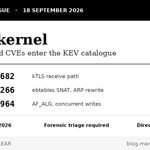
Three Linux kernel CVEs enter CISA’s KEV catalogue with a three-day deadline and mandatory forensic triage. Fixes, scope and how to read the scores.

Patch Tuesday Analysis · May 2026 May 2026 Patch Tuesday: No Zero-Days for the First Time in 23 Months, but Three Unauthenticated 9.8 RCEs in the Queue Microsoft fixes 118 to 138 CVEs depending on methodology, including 16 critical, with no actively exploited or publicly disclosed vulnerability. First Patch Tuesday without a zero-day since June…

Technical Analysis · Linux Kernel Vulnerability Reading Root-Owned Files Without Privilege: What CVE-2026-46333 Reveals About Nine Years of Blind Spot in the Linux Kernel A race window in the Linux kernel ptrace access control allows, via pidfd_getfd(2), the theft of file descriptors held by SUID root binaries about to terminate. Two public exploits exfiltrate SSH…

CTI Analysis · Critical Vulnerability BitLocker Is No Longer a Promise: What the YellowKey Case Reveals Two Windows zero-days disclosed without coordination, a researcher openly challenging Microsoft, and a phantom component in the Windows Recovery Environment whose true nature, bug or backdoor, no one can yet determine. Published May 14, 2026 Reading time 15 minutes…

Remote code execution via the Reading Pane, without user interaction Executive summary On May 12, 2026, as part of the monthly Patch Tuesday cycle, Microsoft released a fix for CVE-2026-40361, a critical use-after-free vulnerability (CWE-416) officially classified by the vendor as a “Microsoft Office Word Remote Code Execution Vulnerability” (1) (2). Researcher Haifei Li, founder…

Universal Local Privilege Escalation in the Linux Kernel Executive summary On May 7, 2026, researcher Hyunwoo Kim (alias @v4bel) publicly disclosed a new class of Linux kernel vulnerabilities named Dirty Frag (1) (2). This disclosure, brought forward as a result of an embargo break by an unrelated third party, exposes an exploitation chain combining two…